
Swift County Parole Versus Probation
The label matters because it points to the right record. Probation is a court-ordered community sentence or condition. It may follow a stayed sentence, and it does not prove that a person ever entered state prison. Supervised release is different. It is the community portion of an executed Minnesota felony sentence after a person leaves prison but remains under Minnesota Department of Corrections jurisdiction. Parole is narrower still. In Minnesota, it mainly concerns people serving life or other indeterminate sentences and certain other populations assigned to the Supervised Release Board.
A person leaving an ordinary county-jail stay may be on probation, may have no supervision, or may have been transferred elsewhere. A person leaving a Minnesota prison may appear as under supervision in the MNDOC Locator. Neither event should be called parole without a record that supports that term. The comparison below keeps the legal routes separate.
| Status | How it begins | Best verification |
|---|---|---|
| Probation | A Swift County court order places the person under community terms, sometimes without a prison release. | The sentencing order, later register entries, and Swift County Community Corrections. |
| Supervised release | A state prisoner serves the community part of an executed sentence while still under MNDOC authority. | The MNDOC Locator status, supervision district, agent or agency, and Minnesota Haven. |
| Parole | The Supervised Release Board acts for a limited parole-eligible population. | The Board record and MNDOC status. A grant does not always mean immediate community release. |
| Final discharge | The sentence or correctional jurisdiction reaches its legal end. | MNDOC Central Records, the court record, or a Board discharge record. |
- Supervised release
- The community portion of an executed state sentence while MNDOC jurisdiction continues.
- Parole
- Conditional community release for the limited population governed by the Supervised Release Board.
- Probation
- Court-ordered supervision that can exist without a state-prison release.
- Discharge
- The legal end of supervision or sentence authority, distinct from the date physical custody ended.
Check Swift County Post-Release Supervision
Begin with the source that matches the custody path. The MNDOC Locator covers adults committed to the Commissioner of Corrections who remain under state jurisdiction. That scope includes people still in prison and people released from prison onto supervision. It is not an all-person list of Swift County probation cases. A local court case can show that probation was ordered, while the local office can explain process and route an inquiry without promising disclosure of private facts.
- Search the MNDOC Locator by the full six-digit offender ID when known, or search by name and compare identifiers.
- Open the correct detail record and read the Current Status line. Do not stop at the name result.
- Look for “Under Supervision as of,” the supervision district, and an agent or agency when those fields appear.
- Confirm the current assignment through the MNDOC Community Services Directory or the office shown in the record.
- For court probation, check the Swift County criminal case and sentencing order, then review later violation or discharge entries.
- If MNDOC jurisdiction has ended and the record no longer appears, ask MNDOC Central Records for the responsive discharge record.
The official MNDOC supervised-release example illustrates the status and office fields used in this process.
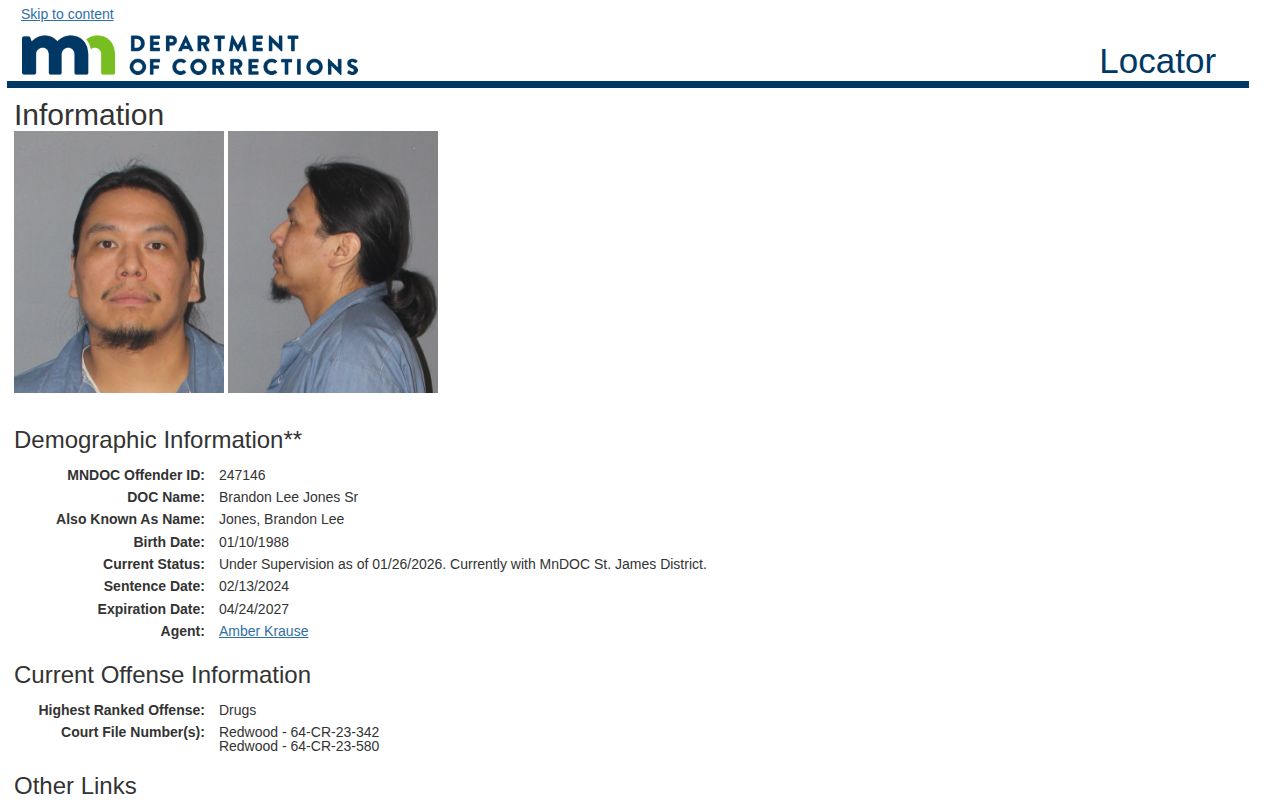
The example is a field guide, not a Swift County roster. Match identity carefully and rely on the live record for current supervision details.
For a fuller release inquiry, the Swift County released-inmate search explains how jail release data, state custody, and court records fit together.
Note: A missing Locator result may mean state jurisdiction ended; it does not prove that probation never existed or that no court term remains.
Swift County Probation Office Route
Swift County uses a Community Corrections Act arrangement. The local route is Swift County Community Corrections, not merely a generic MNDOC field office. MNDOC’s directory identifies the Benson office as serving Swift and Lac qui Parle Counties. Staff and agent assignments can change, so the live directory should be checked before addressing a message to a named person. The office can explain local procedure and route a valid inquiry, but no official public list of all Swift County probationers exists.
The MNDOC Community Services Directory record is the official source for this local contact.
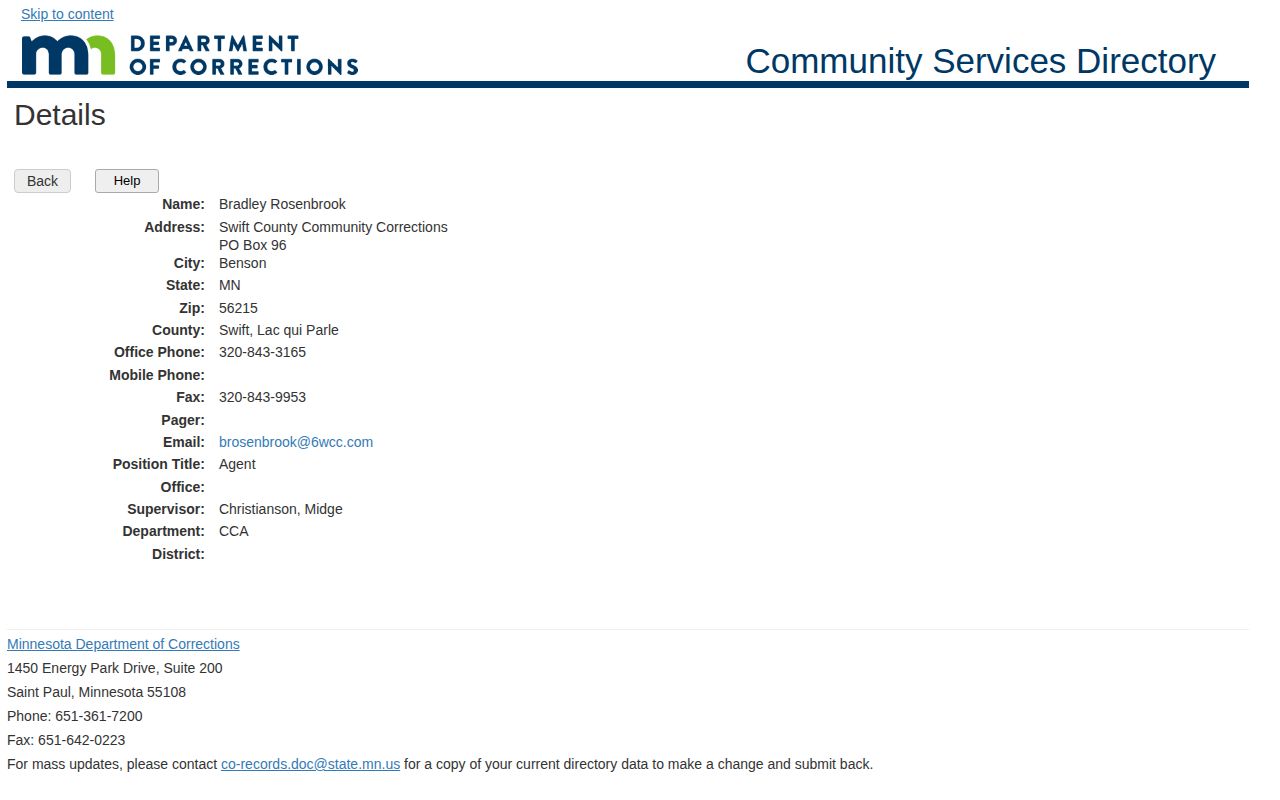
This directory entry is more precise than sending every supervision question to a statewide office, and its live version should control if staffing changes.
Swift County Community Corrections
PO Box 96
Benson, MN 56215
320-843-3165
Fax: 320-843-9953
MNDOC Central Records
1450 Energy Park Drive, Suite 200
St. Paul, MN 55108
651-361-7330
CO-Records.DOC@state.mn.us
Fax: 612-473-5006
Who Supervises Swift County Probation?
Swift County Community Corrections is the specific local supervision route documented by MNDOC. Its Community Corrections Act role means local cases are not all assigned through a standard state Field Services district. The current directory record should be used to confirm which office and staff cover the person’s case. An older printed name or saved contact may no longer be right.
Coverage does not make all case facts public. The MNDOC Locator may show a supervision agency and agent for a person within its scope. A court register may show probation, a violation filing, or discharge. The local office can state its process, but private supervision notes, treatment details, and other protected corrections data remain subject to Minnesota law. Ask for the public record that answers the exact status question instead of seeking an entire supervision file.
That distinction is especially useful after a Swift County Jail release. A jail exit record proves when local custody ended and why. It does not by itself establish who supervises the person next. The court order or MNDOC status supplies that next link.
Swift County Supervision and Warrants
Conditions are set by the court or releasing authority and differ by case. Reporting, travel limits, treatment, and no-contact terms are common types, but no condition should be assumed from a person’s release status. Someone may live in the community while still subject to close control. “Under supervision” means correctional authority continues. It does not mean final discharge.
An absconder is a person alleged to have stopped reporting or otherwise left supervision without authorization. No official public Swift County absconder or probation-warrant list was found. MNDOC has broader fugitive and noncompliant tools, yet each covers a defined population. Failure to appear in one of those tools does not prove there is no warrant. For a named Swift County case, review the court register and contact the authority that issued the warrant.
A suspected violation can lead to a court filing, a warrant, custody, changed conditions, or revocation. Revocation means the court or release authority cancels community status after the required process. The resulting court or agency record, not rumor or a stale search result, is the sound source.
Note: Verify a warrant with the issuing authority before acting; public search tools can omit cases, lag, or cover only narrow groups.
Swift County Supervision Notifications
Minnesota divides notification by custody system. VINE is for county jails and detention facilities. It is not connected to MNDOC prisons. For a person sentenced to MNDOC, Minnesota Haven handles incarceration, release, and community-supervision notices. That split prevents a common error: registering in a county-jail system for a state supervision event.
Haven may provide notice of agent assignment, conditional or final release, sentence expiration, supervision custody changes, an agent change, expiration of supervised release, and a return to community supervision. Registration uses the Haven form sent to MNDOC Victim Assistance, not the VINELink PIN flow. General release notification is available to a person who registers. Contact details must stay current for notices to arrive.
VINE can still matter when the question is whether someone has left Swift County Jail. The statewide program covers participating county detention systems, but Swift County’s live participation should be confirmed in the agency selector or with the jail. A VINE custody change does not replace the court order, jail release data, or MNDOC supervision record.
Swift County Parole Board Limits
The Minnesota Supervised Release Board does not hold a parole-grant hearing for every ordinary prison release. Post-1993 determinate sentences generally follow the statutory supervised-release framework. The Board handles a narrow population that includes certified adults, people with indeterminate or life sentences, and certain criminal-sexual-conduct cases after the applicable minimum term. Calling all released state prisoners parolees blurs this crucial line.
A Board outcome must also be read with the full custody record. Even a grant can lead to another sentence rather than release to the community. The Supervised Release Board hub supplies the official process and current review schedule. The MNDOC Locator then helps show whether the person is incarcerated, under supervision, or no longer within the locator’s active scope.
For probation, return to the court sentence and Swift County Community Corrections. For supervised release, use the MNDOC record and Haven. For the limited parole group, pair the Board action with the current MNDOC status. Those separate routes keep a release decision from being mistaken for a completed discharge.
When Swift County Supervision Ends
Physical release and legal discharge are not the same event. A state prisoner may leave prison for supervised release while the sentence continues. Probation can continue after a county-jail term ends. Final discharge occurs when the relevant sentence or correctional authority reaches its legal endpoint, or when a court or Board enters the applicable action.
Minnesota Statutes section 609.165 addresses discharge after completion or expiration in applicable cases. The best proof depends on the supervision type. MNDOC Central Records can supply responsive state correctional material. A Swift County court register may show probation discharge or a later order. The Supervised Release Board controls records for its limited population. If the MNDOC Locator no longer shows the person, use Central Records and the sentencing case rather than treating no result as proof of status.
A precise request should name the person, identify the case or offender number, and ask for the public record showing the date and legal basis on which supervision ended. Broad corrections files can contain protected data under section 13.85. A focused request is more likely to reach the public fact that answers the question.